Hieroglyphics were assumed to be ideogrammes, symbols and nothing else, standing for ideas or concepts. Failure to realise the difference between them leads to a similar self-imposed intellectual blindness or mental block to appreciating the sophistication of modern human language. Claims that words totally control how and what we think arise from fashionable, dead end intellectual blindness, quite similar to what dominated over 1500 years in those confronted by the mystery of ancient Egyptian language.
‘Concepts’ assume a kind of remote domain where they exist independently of individual minds each with a distinct boundary of meaning. Ideas differ and can arise from the combination of meanings followed by metamorphosis to produce or reproduce meanings and cannot exist without humanity. The distinction between concept and idea is at the root of modern ignorance of the sophistication of language we use.
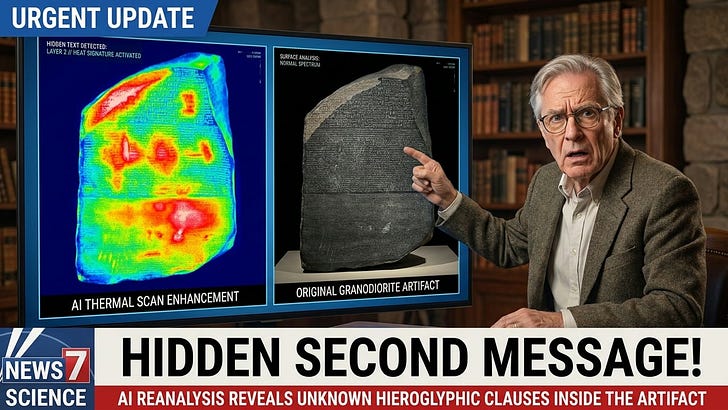
Please ignore the ‘shock horror’ click grabbing headline- this youtube presentation provides a very good historic record of cultural assumptions preventing translation of hieroglyphic text and how it was eventually understood.
The process of discovery started with an assumption that all three texts were bound to include references to authorities such as officials or pharaohs. From this, it appeared that the text was a mixture of phonetic constructions and ideas, not just referring to a bunch of quasi-Platonic forms or ‘concepts’. Thomas Young, (he of Young’s Modulus in physics), set to work on the ovals, called ‘cartouches’, and it turned out they spelt the name ‘Ptolemy’ proving some symbols were phonetic, in this case spelling a name. Obsession with quasi-Platonic forms, now commonly called ‘concepts’, led generations of academics and intellectuals up a dead end path.
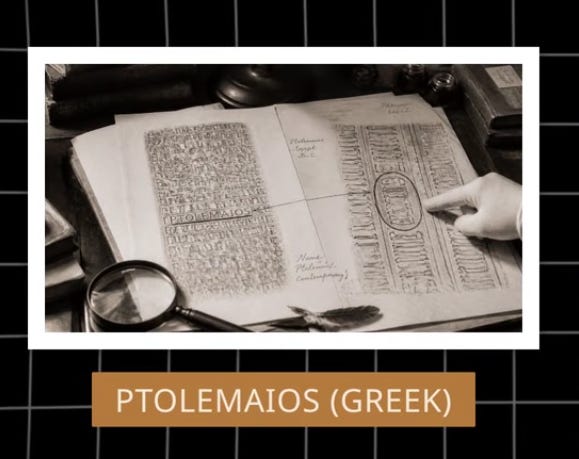
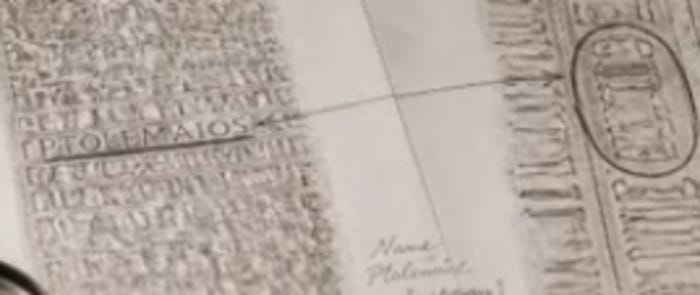
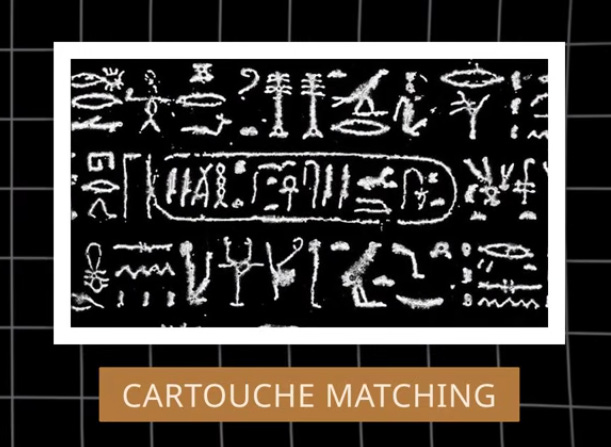
Hieroglyphs are a combination of phonetics to make words, single markers for ideas (like our use of the $ sign) or determinative…. eg, is it about a God, Man, action of place? In this case crucially, a name is not a concept and not an idea. It identifies an individual or group of individuals by phonetic construction of a word.
Champollion was the genius who solved the mystery. His knowledge of Coptic, closely related to the Demotic (although not in script) on the Rosetta Stone, provided information about the sound of Demotic words and, following through the sound of hieroglyphic speech. Devoid of punctuation to determine which combinations of letters and words were to metamorphose into meaning, identifying individual sounds enabled distinctions necessary to combine to create meaning common to the three texts. Recently, it has been found that the hieroglyphic version is rather more absolute in terms of rights and duties than softened Demotic and Greek translations.
The ability to gather meaning from text without familiar punctuation in, say, modern English can be demonstrated by presenting text stripped of it. Intent on seeking meaning, although difficult, it is usually possible to work out what is being said. (The editor of the manuscript of The Severn Pillars of Wisdom had to insert hundreds of commas because T.E Lawrence refused to use them. Had he a similar attitude to paragraphs I expect that hurdle, too, would have been overcome).
The fashionable flawed view of language, particularly that promoted by Wittgenstein, a reiteration found in ‘Whole Word’ teaching of reading and writing, is based on a similar cultural fixation and mistake that words signify ‘concepts’ or ideas when they really stand for phonetics. Isolated words have little meaning but when they combine, useful meaning appears through metamorphosis where the the result is not the logical sum of meanings of words but a product of metamorphic combination.
Concepts in their special heaven or abstract library are distinct, ideas are not. Where an idea can multiply depending on the number of those who know it, concepts are supposed to be singular and special, remote from individuals, designed for us to refer to saving us from the illusion of solipsism. Ideas can result from many combining, hundreds of words, phrases, sentences even paragraphs can combine to make an idea. There are an indefinite number of potential ideas where concepts are carefully controlled by academics and certain parts of the intelligentsia.
In the worse kind of universities academics determine what is a concept and what is not. So creativity, discovery and boundaries of acceptable discussion are most rigorously patrolled, constrained and enforced. The last place you’ll find freedom of thought is in a university department of philosophy. And it’s quite shocking that they did not learn from those who brought back Egyptian hieroglyphical language and some of a long lost culture from the dead.